Some decisions are small and still won’t get made. Pizza or leftovers. Laundry first or dishes first. Text back now or after dinner. You’ve gone over the reasons three times, and you’re still standing in the kitchen.
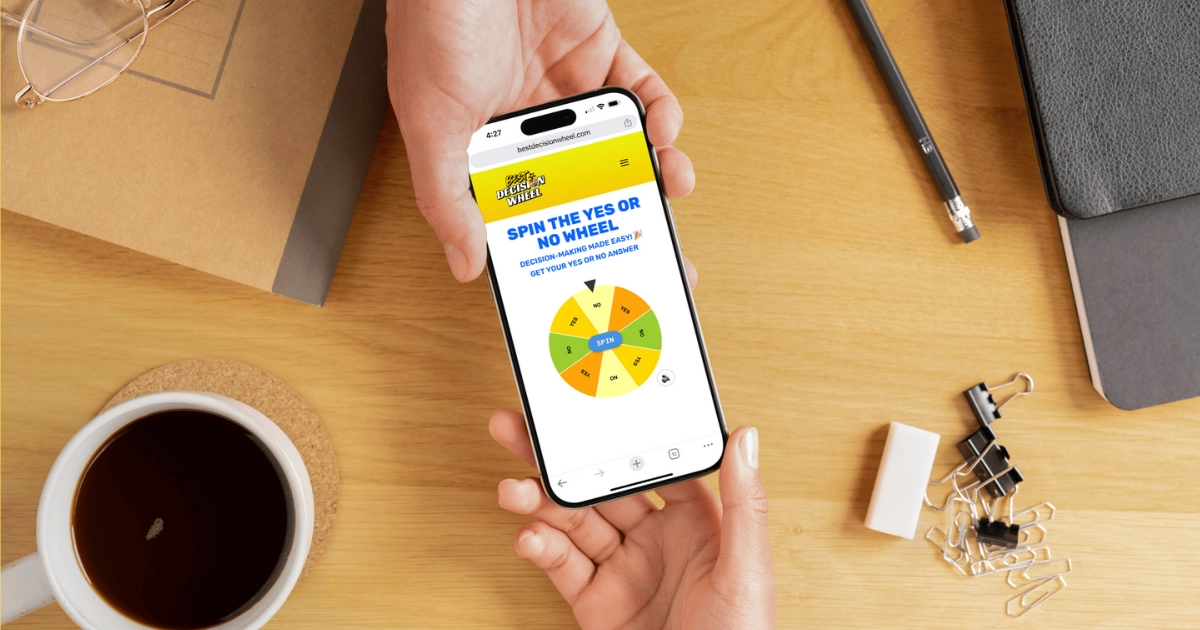
That’s what our wheel is for. Here’s how we use it at home, and how to get a real answer out of it instead of spinning until it says what you wanted.
Why we spin for small things
ADHD runs in our family, and some days even a small decision is hard to make. The thinking part works fine. The starting part is where we get stuck. So we say the question out loud, spin the wheel, and take the answer. The stuck feeling passes, and we keep going.
Dinner was the worst of it. For a while, “I don’t know what we want for dinner” was a game our family played for hours, and it ended in meltdowns or dinner at 10 pm. The wheel ended the game. That’s why there’s a What should I eat? wheel on this site now.
Ask a question the wheel can answer
The wheel can only say yes or no, so give it a question with two real options.
- “Should I order pizza tonight?” works.
- “What should we do this weekend?” doesn’t. Turn it into “Should we go to the beach on Saturday?”
- “Should I take the job?” has two options, and it’s still a bad question for a wheel. More on that at the end.
Say the question out loud before you tap Spin. It feels silly, and it’s half the work. Often, hearing yourself ask it tells you the answer before the wheel stops.
The one rule
Spin once. Do what it says.
If you can’t, you’ve just learned something. If the wheel says NO and your stomach drops, you wanted YES all along, and now you know. Go do the thing. If it says YES and your shoulders sink, that’s worth a second look too.
The rule matters because a wheel you keep spinning until you like the answer is a slow way of deciding what you’d already decided. Spin once, watch your reaction, and go with whichever is louder: the wheel or your gut.
Is it really fair?
Yes. The wheel uses your browser’s random number generator to pick where it stops. We spun ours a million times on a computer to check: YES came up 50.03% of the time, the answer on screen matched the slice under the pointer every time, and the longest run of one answer was 21 in a row. The whole test is in Is a yes or no wheel really random?
The wheel has no memory, either. Three NOs don’t make a YES more likely on the fourth spin, any more than a coin owes you heads.
At work
At work the wheel earns its keep on the choices that have no right answer: which of two equal tasks to start, whether to send the email now or after lunch, which small job to clear in the five minutes before a call. Each one you leave open costs attention you need for the real work, so let the wheel close it.
Keep the wheel away from anything with a cost you’d regret: deadlines, promises to clients, money. Those get a real decision.
Which wheel for which question
- A plain question with two outcomes: the yes or no wheel on the home page.
- “Should I do this, right now?”: Should I do it? says DO IT or SKIP IT. It’s the page people find most on this site, and “should I do it” is the question they type into Google to get here.
- You can’t pick what to do at all: What should I do today? Its Stuck list is all five-minute jobs.
- A text you’ve already written: Should I text them?
- You’d like the wheel to be allowed to say “not sure yet”: Yes, no or maybe.
When not to use it
Don’t let a wheel decide anything about your health, your safety, your money, the law, or someone else’s wellbeing. Those questions deserve a person who knows the facts. The wheel is for the small stuff that’s stalling your day, and it’s very good at that.